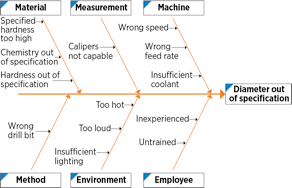
A fishbone diagram, sometimes referred to as a cause-and-effect diagram or an Ishikawa diagram, is a quality tool that helps users identify the many possible causes for a problem by sorting ideas into useful categories.
Fishbone is an American rock band from Los Angeles, California. Formed in 1979, the band plays a fusion of ska, punk, funk, metal, reggae, and soul. AllMusic has described the group as "one of the most distinctive and eclectic alternative rock bands of the late 1980s.
Your local Lutz, FL Bonefish Grill® specializes in hand-cut, wood-grilled specialties and locally crafted Partner Selection dishes made with the freshest, highest-quality ingredients.
A fishbone diagram is one of the various techniques available for conducting cause-and-effect analyses. It provides a structured way to identify and organize the potential causes contributing to a particular problem or effect.
In this post, we’ll break down exactly how to use a Fishbone Diagram, provide practical examples, and tackle common challenges—so you can go from firefighting problems to eliminating them for good.
A fishbone diagram is a visual framework used to identify the root causes of problems by organizing potential causes in a clear, structured format. Learn its uses, benefits, and how to create one with templates for effective problem-solving and process improvement.
A fishbone diagram, also referred to as a cause and effect diagram or an Ishikawa diagram, is a helpful tool for identifying the root cause of a problem. It allows you to list all the potential causes that may be contributing to the effect you are currently experiencing.
A fishbone generates possibilities, not proofs or confirmed root causes. Once you’ve brainstormed causes, prioritization methods like data analysis, multivoting, Pareto analysis, or impact-effort matrices help focus on the most likely contributors.
A fishbone diagram is a visual tool that adds structure and clarity to problem-solving. It indicates the problem and its possible causes in a single location, making it easier for teams to conduct a root cause analysis.
A cause and effect diagram, often called a “fishbone” diagram, can help in brainstorming to identify possible causes of a problem and in sorting ideas into useful categories. A fishbone diagram is a visual way to look at cause and effect.